One Teenager, a $6 Billion Lawsuit, and the End of the Pritzker Dynasty
In October 2002, an 18-year-old actress filed a $6 billion lawsuit against her father and eleven cousins. She was Liesel Pritzker. Her father, Robert Pritzker, had helped run one of the most secretive family empires in American history — a dynasty built on a single run-down motel near LAX, expanded into Hyatt Hotels, Marmon Group's 60-plus industrial companies, a 25% stake in Royal Caribbean Cruises, and a labyrinth of roughly 2,500 interlocking trusts. Liesel said her share of that empire had been stolen from her. And the lawsuit she filed didn't just threaten her father. It detonated the entire thing.
Jay Pritzker's empire — built on one bad motel
The story starts in 1957. Jay Pritzker acquired a run-down motel near Los Angeles International Airport and saw something nobody else saw. He renamed it Hyatt House. Then he built another. Then another. By the time Jay was done, Hyatt Corporation was one of the world's leading hotel brands.
But Jay didn't stop at hotels. He built the Marmon Group, a sprawling collection of more than 60 industrial businesses, and held a 25% stake in Royal Caribbean Cruises. He financed the whole operation — and the family's considerable philanthropies — through approximately 2,500 interlocking trusts, a financial architecture so complex it required its own ecosystem of lawyers and accountants. By the time he died in January 1999, the combined empire was worth roughly $15 billion.
Jay also served a function no trust could replicate. He held 13 cousins together through force of will. The moment he was gone, that function disappeared with him.
Thirteen cousins and a ticking clock
Jay's death triggered a succession crisis almost immediately. Thirteen cousins, each inheriting pieces of a web of holding companies and trusts, had wildly different opinions on how things should run. Nobody had Jay's authority. Nobody had Jay's relationships. Nobody had Jay's patience for keeping peace.
By 2000 — barely a year after the funeral — a seven-cousin coalition had formed. Their grievance: Thomas Pritzker, Nicholas Pritzker, and Penny Pritzker were paying themselves excessive management fees to run the family companies and, the coalition alleged, quietly transferring assets into their own trust funds at the expense of the other heirs. The coalition included Tony Pritzker and J.B. Pritzker, who would later become Governor of Illinois. They wanted out. They pushed for a formal division of the empire.
The negotiations ground on. The family was rich, secretive, and deeply reluctant to air any of this publicly. For two years, the split remained an internal argument. Then Liesel Pritzker decided she had something to say.
The $6 billion lawsuit
In October 2002, Liesel Pritzker — 18 years old, Robert Pritzker's daughter, a working actress — filed suit in Illinois state court. The complaint was precise and brutal. During Robert Pritzker's divorce from their mother in the mid-1990s, Liesel alleged, Robert had emptied the trust funds established for her and her brother Matthew. Assets had been transferred to accounts benefiting other family members and the Pritzker Foundation charity. The children's money, the suit claimed, was simply gone.
The numbers she put on it: $1.1 billion in compensatory damages for herself, $1.1 billion for Matthew, and $5 billion in punitive damages. Six billion dollars. Total.
The nuclear option lands
The lawsuit didn't just threaten Liesel's immediate targets. It threatened everyone. A prolonged public trial would have exposed the full structure of the Pritzker financial arrangements — all 2,500 trusts, all the management fees, all the asset flows — in open court. For a family that had operated in almost complete secrecy for decades, that was unacceptable.
The suit also landed directly on top of the seven-cousin split negotiations, which were already in motion. Now the cousins weren't just arguing about fees and control. They were arguing against the backdrop of a federal courthouse and a teenager who had apparently decided she had nothing left to lose.
The family settled in 2004. Liesel and Matthew each received $280 million in cash plus control of trusts in their names worth $170 million each — approximately $450 million apiece, roughly $900 million combined. That's a settlement for two people who were told their trust funds were empty.
The empire breaks apart
The settlement cleared the path for the larger dissolution the seven-cousin coalition had been pushing for since 2000. It took years. Asset sales, negotiations, restructuring. But by 2011, the $19 billion Pritzker family empire — it had grown from $15 billion at Jay's death — had been fully divided.
Each of the approximately 11 adult cousins, along with Liesel and Matthew as the 12th and 13th participants, received roughly $1.35 billion or more. One dynasty. Twelve-plus billionaires. The family that had been an empire became a collection of individuals, each with their own foundation, their own investment office, their own ambitions.
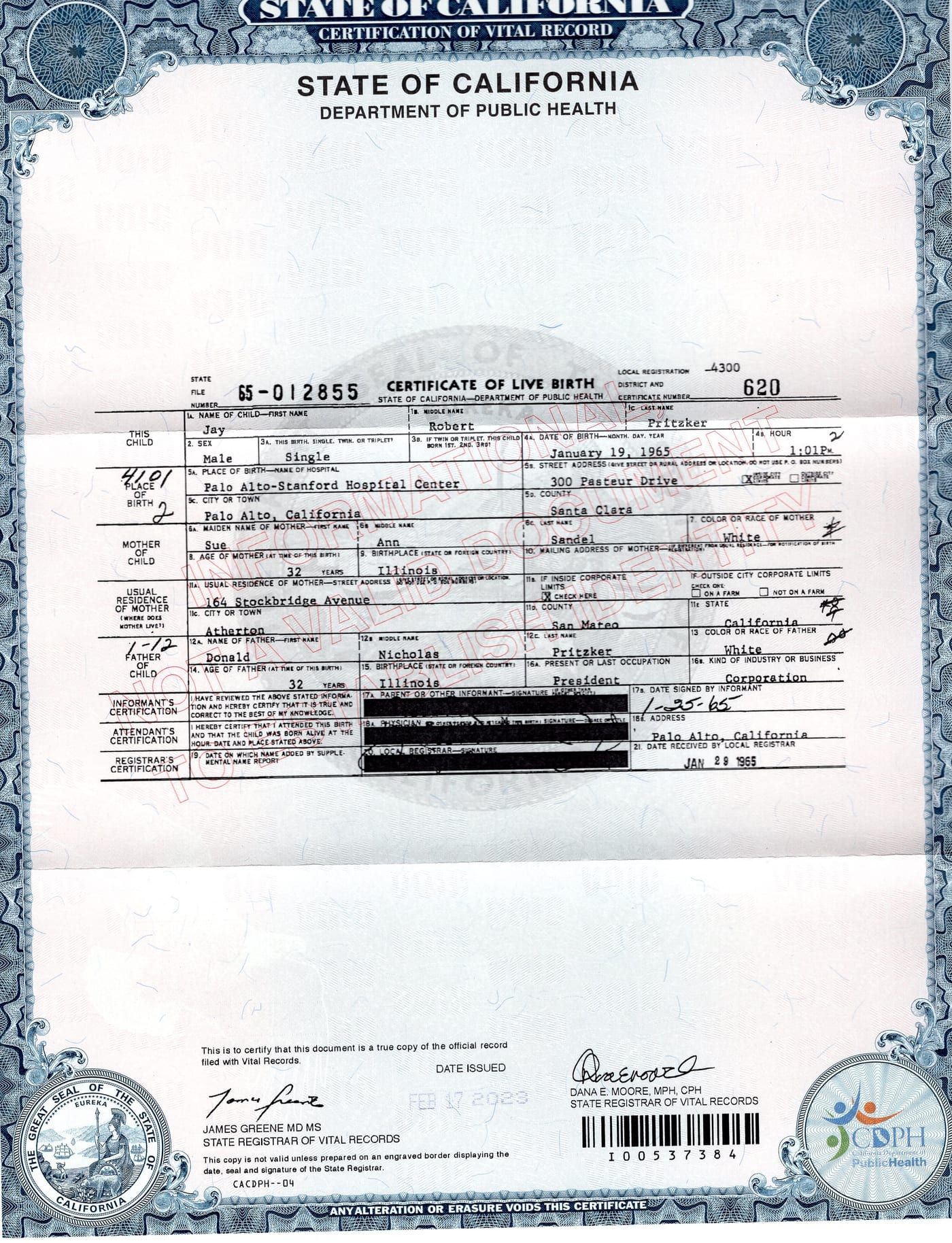
J.B. Pritzker, a member of the seven-cousin coalition that pushed for the empire's breakup, became Governor of Illinois after the dissolution was complete (Photo: Public domain)
What they did with the money
The outcomes are almost surreal in their scale. J.B. Pritzker, who had been part of the seven-cousin coalition pressing for the split, became the 42nd Governor of Illinois. Penny Pritzker, who had been on the other side of the negotiating table as an ally of Thomas and Nicholas, became the United States Secretary of Commerce under President Obama.

Penny Pritzker, who negotiated on behalf of the Thomas and Nicholas faction during the dissolution, later served as U.S. Secretary of Commerce under President Obama (Photo: Public domain / White House) Liesel Pritzker Simmons, the teenager who lit the fuse, became a prominent impact investor and activist — a figure in exactly the world of ethical capital deployment that her lawsuit accused the family of corrupting.
Thomas Pritzker continued running what remained of the family's hotel interests. Hyatt went public. The Marmon Group was eventually sold to Berkshire Hathaway. The 2,500 trusts wound down.
The man behind the curtain
The thing about Jay Pritzker is that his absence was the entire story. He built an empire sophisticated enough to span hotels, industrial manufacturing, and cruise ships. He built a financial architecture complex enough to require thousands of trusts. But he did not build a succession plan capable of surviving him.
When he died in January 1999, he left 13 cousins, a $15 billion pot, and no instructions for what happened when the cousins stopped agreeing. What happened was exactly what you'd expect. First came the accusations. Then came the lawyers. Then came the 18-year-old with the $6 billion hammer.
What a dynasty actually costs
The Pritzker dissolution produced 12 billionaires from a single broken empire. On a spreadsheet, that looks like a success. Everybody got theirs. Nobody ended up with nothing. But the original $19 billion empire, undivided, was worth considerably more than the sum of 12 parts — and the family's collective influence, its ability to act at scale, its decades of institutional knowledge — all of that evaporated in the negotiations.
Jay Pritzker took a single bad motel near LAX and built one of America's great fortunes. It lasted one generation past him. The cousins couldn't agree. The trustees couldn't be trusted. And the daughter nobody thought would make noise turned out to be the loudest voice in the room.
She was 18. She sued for $6 billion. And she was right.
Related Stories
The princess, the secret children, and the $2 billion Wahaha battle
When China's most famous beverage billionaire died, his daughter thought the empire was hers. Then three strangers showed up with HSBC account numbers and a $2.1 billion claim.
The Safra Banking War: Son vs. Mother, Brothers, and a $25 Billion Empire
When Alberto Safra walked out of his family's bank to build a rival, his father was heartbroken — and his family was mobilizing. What followed was a multinational legal war over billions, a dying patriarch's disputed will, and a group chat nobody was allowed into.
The Redstone Wars: How Shari Outlasted Her Father and Sold the Empire He Built
Sumner Redstone spent decades trying to keep his daughter away from his media empire. She got it anyway — and then sold every last piece of it for $8 billion. Along the way: a son bought out for $250 million, a companion evicted from a mansion, a CBS CEO fired in disgrace, and Donald Trump walking off with $16 million on his way to the White House.